
In the end, no matter what, darkness will envelop you. Plague Pit know this. With their new record, the Bristol black n’ rollers have unleashed a torrent of snarled mosh calls and bloodied riffs across the country to a growing cult audience.
Despite their ritualistic first show dating back to this time last year, many of the collective’s members have played together in other projects dating far back to their teenage years across a variety of genres. From the brooding crawl of grunge to the cold sweat of post-punk, it’s safe to say that Plague Pit’s influences range far beyond the oft-derivative styles of black metal and hardcore. Less Southern Lord and thrash, more Nick Cave and Clive Barker’s Cabal. I sat down over a few pints of Guinness with the band’s vocalist, William Briscoe (he/him) and guitarist, Liam Evans (he/him) to talk humble beginnings, Yngwie Malmsteen, and medieval fantasy. Stab the night.
What kind of reception were you expecting from your first show? Folded arms and headbanging or slam dancing and two-step?
Will: We were playing with Knoll, and although we take inspiration from that kind of music, I think it is quite different to what we play, as far as niche subgenres of metal go, so it was hard to gauge what the reaction would be.
Liam: It was in Bournemouth. All things considered, I think it was a strange first show. Normally it would be in local bands in a local venue.
W: We were booked at the last minute as well. We turned up to Bournemouth and were a little bit panicked that no one would turn out for us, or if they were, people wouldn’t be into it.
L: But it went really well I’d say. The crowd was definitely more metal, as opposed to the hardcore crowd. It was reassuring to know that the metal scene, the grind scene, accepted us, and had really nice things to say about us.
W: People were really enthusiastic during the set, where I expected more crossed arms and head-nodding. It really reminded me of how I was going to metal shows as a thirteen year-old, a lot more “hell yeah”, big horns in the air, as opposed to chin-stroking.
L: On that note, it was quite a young crowd there, like teenage metalheads. It was cool to see as I didn’t know much about the music scene in Bournemouth. Seems like it’s popping for the kids down there.
W: All I know of that scene is that I know people from Bournemouth who don’t live there anymore, who are in hardcore, extreme metal, and noise projects, like Dean (Knifedoutofexistence, Playworker) and Mike (Fleshlicker), so that was my only reference point to Bournemouth. But the young crowd for a lot of our set was really fun.
You’ve described yourself as “True Medieval Hardcore”. Can you define this for us? Is it more serious or more tongue-in-cheek?
W: It’s definitely slightly tongue-in-cheek, but I try to write lyrics that are dark fantasy inspired, and I found it more satisfying to ground that in medieval history. As opposed to being super whimsical, it’s more about the daily grind of serfdom instead of fighting dragons. Describing it as “true medieval” was more of a nod to what I was drawing inspiration from, as opposed to anything super aesthetically medieval. We’re not wearing armour or anything like that. But a hint of tongue-in-cheek, because it’s impossible to do this kind of music without a level of self-awareness. I don’t think we’re a corny band, but there’s definitely an element of theatrics to it. I think that using “true medieval misery” as a mosh call is embracing the theatrics of it, and being self-referential to the history of the more extreme elements of the band’s influence, as well as wanting it to be more factual, not just pure low fantasy.
I really wanted everything to be singular, so everything is consistent across the imagery, lyrics, sound… all coming together to create one uniform vibe. “True medieval misery” is a declaration of that and sets the tone for our show. It was something I came up with ages ago when I was talking to a tattoo artist about helping them design a t-shirt for their studio, and I had been talking about wanting to put that on the back of a shirt. That never materialised, but I’ve had it in my mind for about five or six years, and this band felt like the opportunity to focus in on those aesthetics.
A few of your members have played together in other bands for a long time. Tell us about that dynamic, and how it affects your songwriting and performance.
L: There’s a bit of a backstory. We all met when we were sixteen years old. We all went to college and studied music together. We first formed a band at that time that sounded very different to what we’re like now, more of a grunge band. We did that for a few years with three members of the current lineup of Plague Pit. Moving on a few years when we all moved to Bristol, we started a band called Cruelty, which at the time was a different three members. So in different forms, we’ve been together for more than ten years. That’s a long time.
W: Me and James (percussion, he/him) were playing in shitty pop punk cover bands in secondary school, and I think we’ve always felt comfortable writing together. Even before the grunge band, we were doing songwriting assignments at art school together, and that was including Will (Price, bass, he/him) as well. We’d all been consistently learning how to write songs together, so it’s nice to know how each other work. Because of that, coming into Plague Pit, it felt really natural to write these songs, and it was a genre we hadn’t written lots of before. The metal and hardcore aspect of it were the aesthetics, so we’d write the songs we’d feel comfortable writing, then think “how do we make this heavier, groovier in parts, more extreme in parts”.
L: It’s weird that it’s taken us this long to form a band in this genre, because it’s a genre we’ve all loved and bonded over, since we were sixteen. We all loved metal music and hardcore music, listened to it together… the best thing about Plague Pit is that it feels like the thing I’ve wanted to do for so many years, and I think the others feel the same.
W: Me and James were in a hardcore band, which was my first band, and having that background was really useful ‘cause it felt like we were coming back to it almost, just on a more extreme level. That [band] was very much more hardcore punk, teenagers playing fast and loud. It was nice to draw on that experience to write good songs, rather than just fast songs. It’s definitely something we’ve all been interested in, just never, for whatever reason, done together.

How does a songwriting session usually conduct itself for you?
W: The first load of songs we wrote were just me, Liam and James, so we didn’t have a bassist or a second guitarist. It’d more often be Liam coming in with a riff that he’d been jamming at home, and we’ve always been good at jamming together until it’s turned into a full song. Playing a riff four times and then [asking] “what feels natural to come after that?”, and then building on it based on improvisation, then putting the vocals on top once the structure is there. That’s always kind of worked for us, in terms of making it more fluid.
L: It’s a bit different to music we were playing in previous bands, because we don’t think of these songs as “traditional” song structure. “This is the verse, this is the chorus, let’s go back to the verse, etc”, it’s more of a flow of energy and what feels right coming after a certain part. We could write a song that consists of five completely different parts, but the energy flows right, and the riffs flow right, and it feels good to us and it’s fun to play, [so] we’ve thrown that “traditional” malarkey out the window.
W: The structure feels a lot less restricted to “verse, chorus, verse”, which is really nice to break out of [after] being stuck in it for years. The thing we’ve always really struggled with, and what Plague Pit has allowed us to push out is rejecting ideas early on ‘cause they feel a certain way. Like, we’d start with a riff, play around with it, think “this feels too rocky, this feels too heavy metal, this feels too obvious”, and we’d just be done with it. Whereas now, we can come in with a pretty trad rock riff, and there’s still room to make it not that, rather than immediately binning it off. “This is a pretty headbangy part”, but that can work if it’s surrounded by these other bits, or we’ll add this style of playing or this style of vocal to it, and take it out of the trappings of the genre. I think it’s allowed us to write a lot faster because we’re not chucking out idea after idea that feels too much like a predetermined idea we have in our head. It’s a lot more open and fluid.
There’s already a big concept behind the band since your inception. Tell us about the Hessian Veil.
W: I was really struggling with writing lyrics for Plague Pit when we first started, because I always fallen into very particular phrases or trappings of genre, and when we first started, I was going back to these comfortable rhythms and phrases that I’d always written lyrics in. An exercise to get out of that was writing fantasy short stories outside of the band. I started to build up this lore of the Hessian Veil, which is the universe that all these short stories were set in. Once I started to do that, I noticed I began breaking out of these patterns of language and rhyming structures that I’ve always caught myself up in. So I condensed these short stories down into the Plague Pit lyrics. What started initially as a writing exercise expanded how I wrote in general and became a useful tool. We’d have a song that I’d get a particular vibe from, and think, “how can I take this core world that I’ve been writing in, and make a story that fits”.
The Hessian Veil is a dark fantasy universe that’s post-apocalyptic in the sense that the world is dead, but it’s not post-apocalypse in the sense of Mad Max, more based in medieval history. A curse has fallen upon this land that’s killed everything off. Crops won’t grow, etc. There’s this illness and miasma that floats across the world, and within that, all these individual stories are told which make up songs. So there isn’t an overarching narrative, it’s more like days in the life, “monster of the week”-style writing all set in this universe. So there are reference points to other songs and events happening within the world. The Hessian Veil itself is this doomed world where there are different sects of a religion worshipping a dead god, finding their own way to survive, or cope with the fact that the world is dead. Within that, individual, more personal stories can be told.
Between each of your members you share a diverse array of outside influences. Have you always approached the songwriting side as metal-influenced hardcore or did it start with a different sound?
L: I think we all came to the agreement that we wanted to do a heavy band. That’s all we really started describing it as, and from there, all of our influences are kind of different. Being in a heavy band means something slightly different to each of us.
W: I think we all have different ideas of what that heavy band would manifest as in terms of specific genres. When we all came to writing songs together, there was a moment where we were all thinking “there are all quite different sounds actually”. Rather than let that be a hindrance where we fall out and fight over sounds, we try to cram everything in as much as we can. Which initially felt a bit disjointed where we’d have parts which are fast and thrashy, then go into really doomy parts… it felt like we were playing two completely separate songs wedged together. For ages we really struggled with every new song we were writing not feeling like that last one, whereas now we’ve really honed how all these disparate elements fit together. We can write something that’s really thrashy, then has a doom part, but they transition into each other a lot more. Because there’s more of a catalogue of songs to pick from, nothing feels too disparate. It doesn’t now feel like “we’ve written a Power Trip song and one Wallowing song”, it now feels like we’ve written another Plague Pit song.
L: On the demo we released, instrumentally it’s very hardcore-influenced. Maybe because that’s my influence coming through. But the songs we’ve written since then are harder, heavier… in a hardcore sense but also a metallic, heavy sense. The songs [we have now] sound more like us rather than the bands we were trying to sound like.
W: We’ve taken all those parts and made a consistent sound out of it, rather than being separate elements in the same song.

You’ve played a lot of shows across the country already. Do you align yourself with a particular scene, for instance, the Bristol punk and metal scenes?
W: I think we’ve struggled to find a scene we can fit in fully. We’re starting to carve out more of a niche for ourselves, but we were jumping on shows as and when they came up. So I don’t think there’s a particular scene at the moment we align ourselves with.
L: And that’s not a negative thing at all. Some of our best friends are killing it in the Bristol punk scene. The alternative and heavy music scene is better here than it has been the whole time we’ve lived here, I would say. Lots of bands coming up and selling out shows… it’s great and we’re all really good friends with those people as well. Musically we’re maybe slightly different to that, but I think that’s the beauty of us, that we can play on those bills when they’ll have us.
W: We could be one of the heavier bands on the hardcore shows, and one of the lighter bands on an extreme metal show, and it always fits fairly well.
L: That’s why it’s been fun to play shows outside Bristol, to see other scenes. We played in Nottingham a few months ago which was really cool. Lots of bands in a similar vein to us there, a strong scene there. It’s been good so far, who knows where we’ll go next.
W: Coming from Cruelty, we were quite a heavy post-punk band. We were always seen as the hardcore band for post-punk kids and the post-punk band for hardcore kids. Having that “outside of a scene” history, we expected that straight away from Plague Pit anyway, where we wouldn’t necessarily be playing the same kind of shows with the same kind of bands. Instead we were happy to jump from sound to sound and scene to scene, and not limit ourselves to one specific thing.
Question for Will: Can you give us your top three lyricists of all time? Do they influence your lyrics or perhaps your presence onstage?
W: My favourite lyricist of all time is Leonard Cohen, and how I think about songs in general has always been influenced by him. I don’t know how much that influences shows because he’s pretty impossible to emulate.
His music’s more poetic.
W: Exactly, and I’m a lot more blunt in my lyrical delivery. But I always strive to be a bit more poetic, I just haven’t quite managed it. I think a lot of old folk music is where my lyrical inspirations lay, because of the storytelling nature of it. Neil Young would be another big one, and Paul Simon. [They’re] probably my big three for lyric writing, which isn’t very “cult” of me, but again, they all just tell these stories, in quite disparate ways as well. Neil Young and Leonard Cohen are a lot more poetic, whereas Paul Simon is a lot more blunt and direct in his storytelling. I try and pull little bits from each of those.
In a more direct metal influence, Chip from The Body has been really influential on Plague Pit’s lyrics, especially on the first couple of records that they did. A lot of the imagery he uses is stuff that I’ve always been interested in, on songs like Empty Hearth and A Curse. A lot of the apocalyptic imagery is very key in terms of what I was initially writing the short stories that inform the Hessian Veil lore. The same with Kristin Hayter (Lingua Ignota, Reverend Kristin Michael Hayter) as well. Big, grandiose religious-inspired imagery. They’re the most impressive in extreme music right now. A lot of that imagery I’ve always found an affinity with.
Do those two artists influence your performance?
W: Kristin Hayter definitely. There’s a level of visceral intensity in her performance while still being theatric. A lot of the time I think there’s a misnomer that to be truly intense and visceral it also has to be brutally honest, and there be no separation between you as a person and you as a performer. Whereas with Kristin Hayter as Lingua Ignota, there was a level of separation, and those songs are still deeply personal, but the show was still a show. The performance was very much larger than life while still being genuinely terrifying, and quite brutal in its intensity and punishment on the audience. There doesn’t have to be a direct confrontation, face to face, to create something intensely moving.
And for Liam, same question: Can you give us your top three guitarists? What comes straight to your mind?
L: The one guitarist that comes to my mind… [laughs], is the guitarist and the band that got me into heavy music in general… it’s Synyster Gates from Avenged Sevenfold. He was just my guy growing up. Loved that band. They just wrote such huge bangers, really good songs, and such an incredible guitarist. I remember when I was thirteen or fourteen, I bought a Schecter, which is the brand of guitar he uses. Couldn’t quite afford his signature model unfortunately. I bought one of them with a Floyd Rose because I wanted to be him. We share the same birthday as well.
…and number two and number three?
L: That’s a much more difficult question. I don’t really think of guitarists themselves, I more think about the sounds of the band as a whole. When I was studying guitar, I had to force myself to get into the virtuosos like bloody Yngwie Malmsteen. That’s a good shout in itself, Yngwie is unbelievable as far as shredders go, but it’s not something I’ll sit down and listen to.
You’re impressed by it, but it’s not something you’ll seek out to emulate.
L: 100%. I did, at one point, when I was really into learning guitar when I was younger… that’s what I wanted to do… learn how to shred, and be the best guitarist I possibly could. But after studying music for seven years in total, that whole idea kind of died for me, and I was much more infatuated with making good music with my friends, which I’m still doing.
Two bands that spring to mind that have influenced both of the bands I’ve been part of more recently… around the time that we were in college about ten years ago, I remember sitting in the IT room and finding the music video for I Am King by Code Orange, and I had never heard guitars sound so evil, menacing, terrifying. I honestly couldn’t believe what I was hearing, and they became a favourite for us. The I Am King album is one of my favourite heavy records I know. It’s unbelievably hard. Going back to Cruelty, something that I used a lot in my guitar playing was repetition, almost monotonous guitar lines, single notes, barely touching a chord. A band that was influential in that was Ceremony. Sick, for example. The song’s whole intro is just one note, and every time they play it live, it goes off. It goes crazy. There’s a beauty in the simplicity of that and they were a big inspiration.
W: I think minimalism in Plague Pit riffs is a big part of our sound, and not overcomplicating or overplaying. Which ties into hardcore and black metal.
Thanks for taking the time to speak with us. Anything you wish to sign off on?
L: Shoutout Sunny. Shoutout Scott. Shoutout Tim Birkbeck. Shoutout Guinness.
W: Hail Satan. Fear the Hessian Veil.
Plague Pit’s new record, A Whispered Curse, is now available on physical and streaming. Turn off the lights, burn some candles, and let the darkness envelop you.
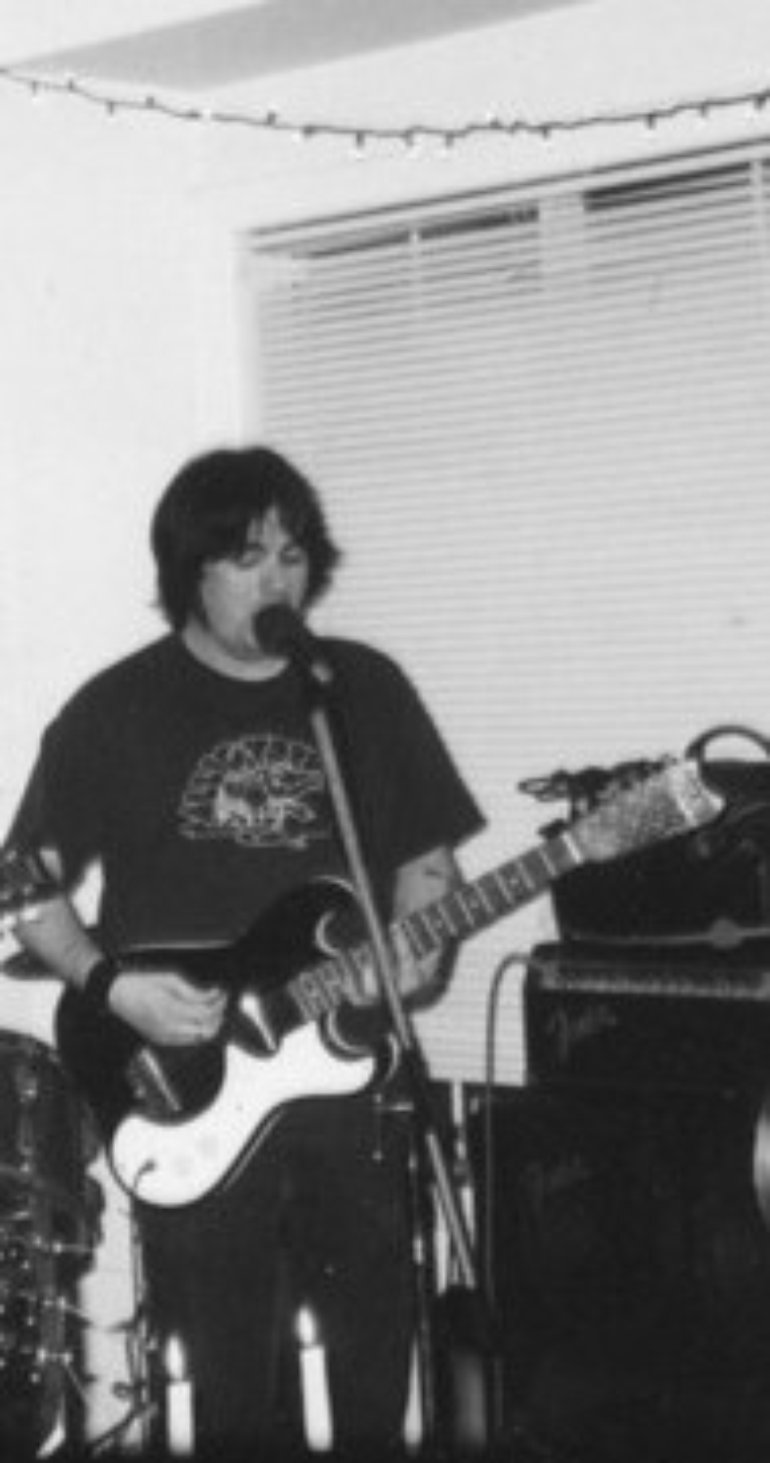
You can find Plague Pit on Instagram and Bandcamp. Photography by Tim Birkbeck.
This feature was powered by:
Discharge – Why (1981)
Waka Flocka Flame – Flockaveli (2010)
Funeral For A Friend – Casually Dressed & Deep In Conversation (2003)



 Relationships are hard to keep in your twenties. It’s guaranteed to be a decade of nonstop reflection and re-evaluation of the energy you give and have given to loved ones. UK emo rockers Way Back When are a sentimental troupe of dreamers whose art is a coping mechanism for this dilemma we all face. Despite being based between the two cities of Durham and Bristol, the band’s transatlantic sound borrows heavily from midwest emo crybabies and British math rock, eschewing angular rhythms for driving percussion and delicate, cascading guitars. Drawing comparisons between There Will Be Fireworks and Algernon Cadwallader, the band’s debut record Retrospectacular drips with misty-eyed reflections on companionship and quarter-life crisis lyrics. Lead guitarist and songwriter Kyle Hawkes effortlessly recites labyrinthine, gliding guitar passages while vocalist/lyricist Tom Lowman delivers soaring vocals with a charming English panache, with lyrics that echo the mutual anxieties of suburban towns and chaotic cities. With all this considered after dropping their impressive debut, I invited Hawkes and Lowman to curate a mix of their key influences for Retrospectacular. Stream the record below and then delve into their inspirations.

 Pop music is not infallible. We still continue to absentmindedly consume vacuous chart singles while still questioning their authenticity and their larger role in a commercial industry, but the ethics of pop appear to be a much more modern debate. In particular: gender. The intersection between modern feminism and the advent of social media has opened up debates about gender politics in pop music where artists are given more autonomy over their own image. It carries such gravitas that


